Parish Church of Arnad

Edited by:
Massimo Martini
Introduction
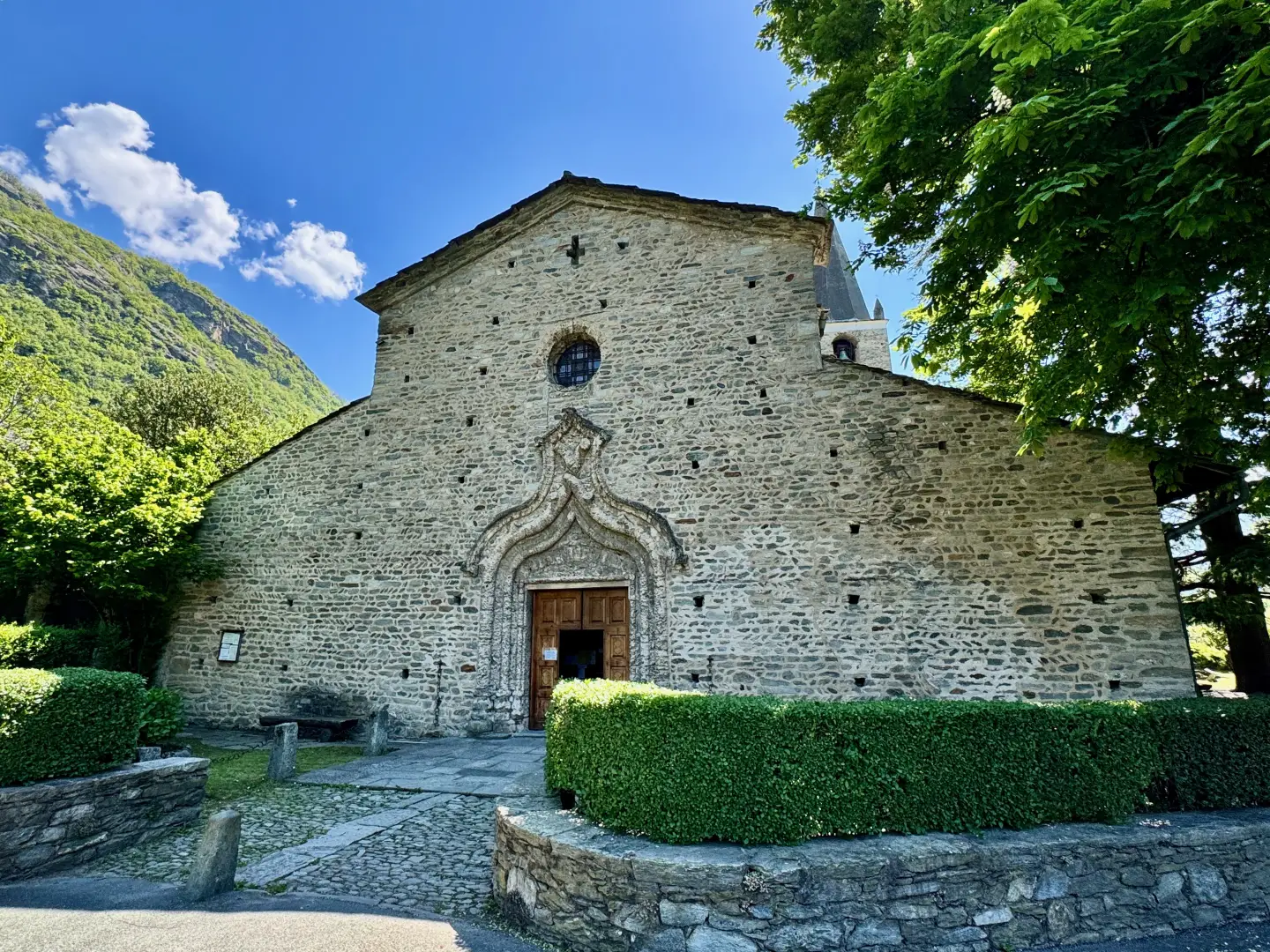
Set in the heart of the medieval village of Arnad, the Parish Church of San Martino stands out with its austere elegance among the mountains of the lower Aosta Valley. Built on a gentle slope overlooking the Dora Baltea, the sacred building blends in with the surrounding landscape, where terraced vineyards and chestnut groves outline an area rich in history and traditions. Its origins date back to the 11th century, when it was built in Romanesque style, but its current appearance is the result of successive transformations, especially in the 15th and 18th centuries, which enriched its architecture and interior. Today, the church is not only a place of worship, but also a symbol of identity for the local community and an unmissable stop for those exploring the artistic heritage of the Aosta Valley.
Description
The simple, linear façade conceals a surprising interior, where Romanesque, Gothic and Baroque elements intertwine. The single nave, covered by a barrel-vaulted ceiling, preserves fine 15th-century frescoes, including a Madonna Enthroned with Child attributed to the workshop of Giacomino da Ivrea. The semicircular apse, typical of Romanesque architecture, houses a Baroque high altar in carved and gilded wood, while votive chapels decorated with statues and devotional paintings line the side walls. Of particular interest is the campanile, a massive tower with double lancet windows and battlements that testifies to the building's original defensive function.
The church's history is closely linked to that of the village of Arnad, an ancient stop along the Via Francigena. In the Middle Ages, Saint Martin was a point of reference for pilgrims on their way to Rome, and even today, every 11 November, on the occasion of the patron saint's day, the community gathers to celebrate the saint with a procession and a festival where typical products, such as Lard d'Arnad - a Slow Food presidium - and local wines are tasted. A popular legend has it that, during an invasion, the faithful hid the saint's relics under the altar, saving them from desecration: since then, it has been said that anyone seeking them without permission would be struck by a mysterious misfortune.
For visitors, the church is accessible all year round, with opening hours varying according to liturgical celebrations. Admission is free, and in the summer months it is possible to participate in guided tours organised by the Arnad Tourist Office, which also include the nearby Castle of Arnad-Le-Vieux, another medieval jewel. Those arriving by car will find parking nearby, while those who prefer public transport can count on the regional buses that connect the village to Aosta and Ivrea. Once here, it is worth climbing up to the churchyard to enjoy a breathtaking view over the valley, where the colours of the seasons - from the white of winter to the deep green of summer - always offer new impressions.