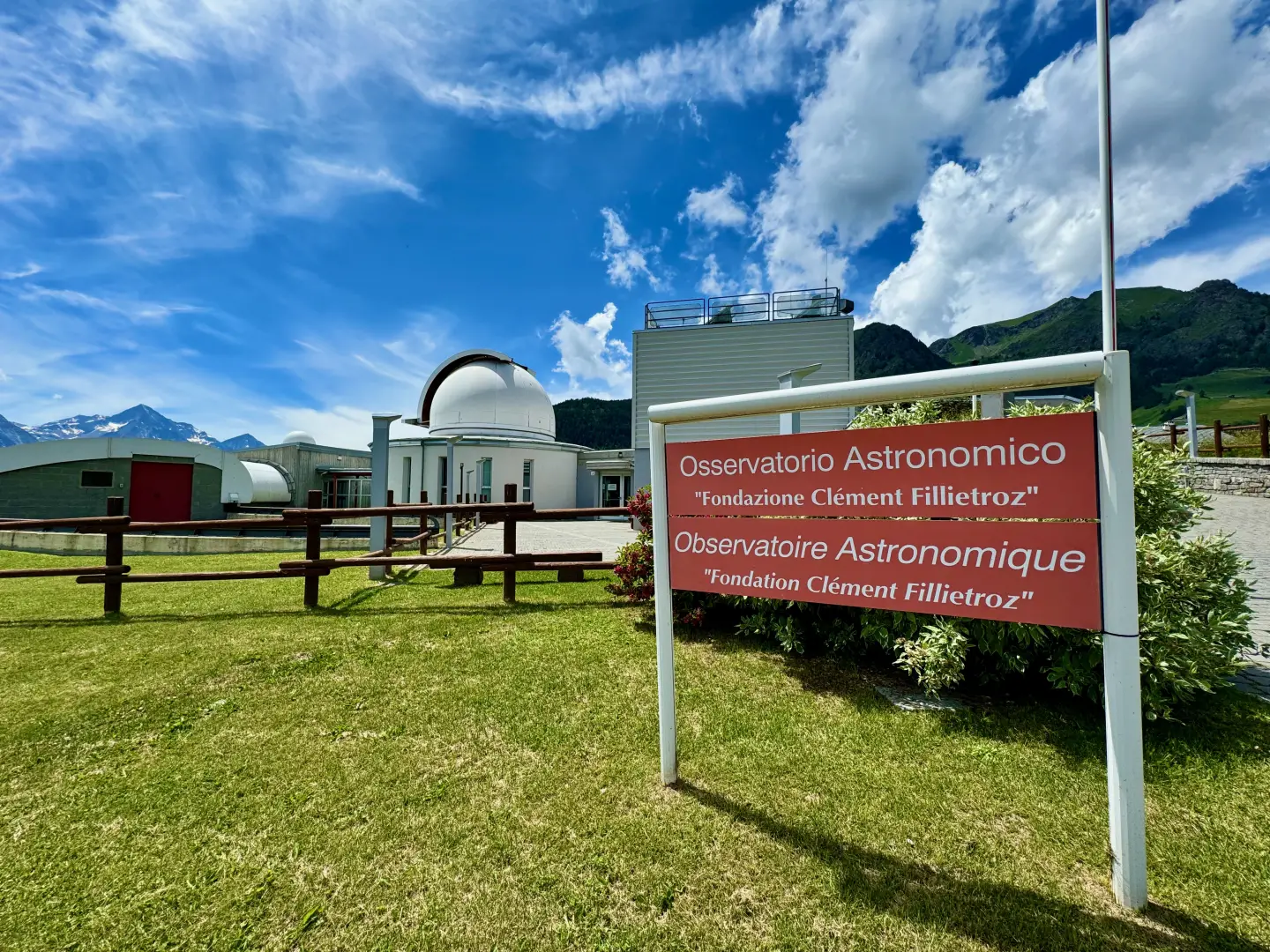
Clement Fillietroz Foundation" Astronomical Observatory

Edited by:
Massimo Martini
Introduction
In the heart of the Saint-Barthélemy valley, in the commune of Nus, at an altitude of approximately 1,675 metres, the Saint-Barthélemy Astronomical Observatory represents one of the most significant scientific presidia in the western Alpine arc. Set in a high mountain environment that is still intact, far from the main urban centres and protected by natural light isolation, the observatory is located in a wide and bright basin during the day, which turns into one of the clearest skies in the Aosta Valley at nightfall. Lignan, a small Alpine hamlet with traditional rural architecture, thus becomes a meeting point between landscape, research and popularisation, in a rare balance between nature and science.
Description
The facility was set up in the 1990s on the initiative of the Valle d'Aosta Autonomous Region with the aim of providing the territory with a centre dedicated to astrophysical research and the dissemination of scientific culture. Dedicated to the memory of Clément Fillietroz, a passionate divulger from Valle d'Aosta who died prematurely, the observatory has had a dual vocation from the outset: professional research on the one hand, and education and awareness-raising for the public, particularly schools, on the other. In a regional context historically linked to the mountains and the observation of the sky as an element of identity - just think of the importance of star orientation in Alpine culture - the establishment of the observatory has consolidated a new cultural symbol for the Aosta Valley community.
Architecturally, the complex integrates discreetly into the surrounding landscape. The compact volumes, sober cladding and the choice of placing the observatory domes in a dominant but non-invasive position testify to a design focus on environmental sustainability and visual impact. The most recognisable element is the dome housing the main telescope, an 81 centimetre diameter reflector, a professional level instrument used in research campaigns on variable stars, exoplanets, asteroids and transient phenomena. Next to the science area is the digital planetarium, equipped with an immersive dome, which allows a multimedia narration of the cosmos and represents one of the most effective dissemination tools in the entire region. The co-presence of laboratory, conference room and observation terrace for the public makes the complex a true cultural centre dedicated to astronomy.
Over the years, the observatory has participated in national and international research programmes, contributing to monitoring campaigns and precision photometric studies. Its location, characterised by low light pollution and good atmospheric transparency, makes it one of the most suitable sites in the Alps for amateur and professional astronomical observation. At the same time, popular activities have taken on a central role: public observation evenings, cycles of lectures, workshops for students and introductory astronomy courses punctuate the annual calendar, with a focus on the experiential dimension. Direct observation of the stars, guided by specialised operators, restores to the visitor that perception of the starry sky that has almost disappeared in urban contexts.
Over time, an identity narrative has developed around the observatory, linking the mountain to the sky. The clear nights of Saint-Barthélemy have become part of the local imagination and there is no shortage of popular tales attributing to the stars a role of guidance and protection for those who walk the high-altitude trails. In this sense, the observatory is not only a place of science, but also a space for the cultural re-appropriation of the night landscape, a fragile and increasingly rare element.
The use of the observatory is organised by reservation, with a calendar that varies between the summer and winter seasons; activities include guided tours, planetarium projections and telescope observations, weather permitting. The site can be reached by car from Nus by driving up the regional road to Saint-Barthélemy; during the winter, accessibility may depend on snowfall, while in the summer the visit can be included in hiking itineraries towards the Porliod basin or along the panoramic paths in the valley. In the vicinity of the observatory, there are rest areas and starting points for walking trails, which make it possible to combine the scientific and natural experience.
In an area known mainly for its peaks, castles and alpine routes, the Saint-Barthélemy Astronomical Observatory introduces a complementary, vertical dimension: that of looking beyond the mountain horizon. It is a cultural garrison that broadens the very concept of heritage, including the night sky among the assets to be known and protected, and that restores to the mountains of the Aosta Valley a new centrality in the dialogue between man and the universe.