Erésaz

Edited by:
Massimo Martini
Access
Access to Eresaz is provided by a communal road that runs from the central valley, past the towns of Saint-Vincent and Montjovet, and climbs gently towards the centre of the hamlet. There is a regular bus service departing from Châtillon, which is also useful for those wishing to use public transport to visit the village and its trails. There are parking areas near the town hall and the church of San Rocco, and the village is an ideal starting point for various hiking routes, including the one to Col Tzecore or the traverse to Val d'Ayas.
Introduction
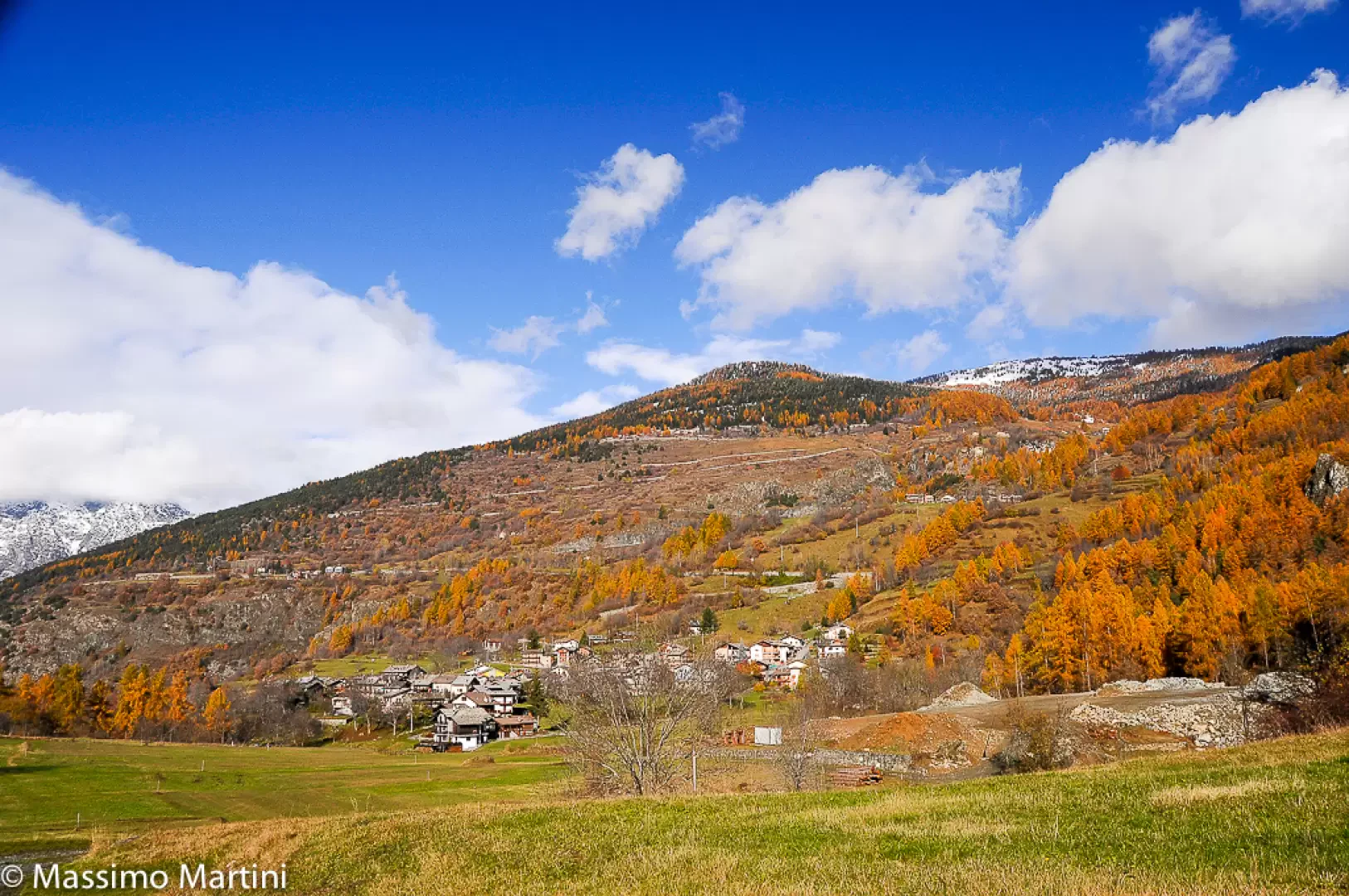
Eresaz is a mountain hamlet of the municipality of Emarèse, located in the mid-to-high Valle d'Aosta, on the sunny ridge separating the central valley from the Val d'Ayas. The village is located at an altitude of about 1135 metres and is not only the main settlement of Emarèse, but also the seat of the town hall and administrative and historical reference point for the entire area. The landscape context is characterised by wooded slopes, large clearings and panoramic views of the valley slopes, outlining a typical Valle d'Aosta mountain environment, where the link with nature and agricultural traditions is still strongly perceivable.
Description
The historical origins of Eresaz are intertwined with the millennial history of the region: in medieval documentation, the village was already listed among the possessions of the Church of Sion in the 13th century and, in the following centuries, it passed under numerous local seigniories, including that of the Challant and Decré families, who left their mark still visible today in the settlement structure and in the historical buildings of the area. The very etymology of Eresaz and the surrounding villages is the subject of study: according to some hypotheses, Eresaz derives from the Latin 'arcensis', meaning 'plateau', an element that reflects the morphology of the territory, marked by gentle meadow terraces alternating with deciduous and coniferous forests.
The natural landscape shows a rich presence of chestnut groves, springs and streams used for irrigation over the centuries; famous, in particular, is the historical network of 'ru' (irrigation canals) including the Ru d'Arlaz, which still marks historical paths and allows easy and scenic excursions between the various hamlets. From a naturalistic point of view, it is worth mentioning the Borna da Ghiasa, a glacial cave located nearby, historically used as a natural food storehouse, an example of adaptation to the difficult environmental conditions of these lands.
The village preserves a chapel dedicated to San Rocco, the local patron saint, which still represents the heart of religious and community life: the structure, restored between 1978 and 1979, hosts the patron saint's festival every year on 16 August, attended by locals and holidaymakers. Gastronomic traditions include the presence of fractional ovens still active for baking black rye bread, evidence of the importance of self-production and historically prevalent subsistence economies. In fact, the local economy has always been linked to farming cereals, potatoes, chestnuts and livestock, with winter being the traditional time for slaughtering and preserving meat, often in the Borna da Ghiasa.
Information
Quota: 1195m
Alternative Name: -
Populated: yes