Chapel of Les Crêtes

Edited by:
Massimo Martini
Introduction
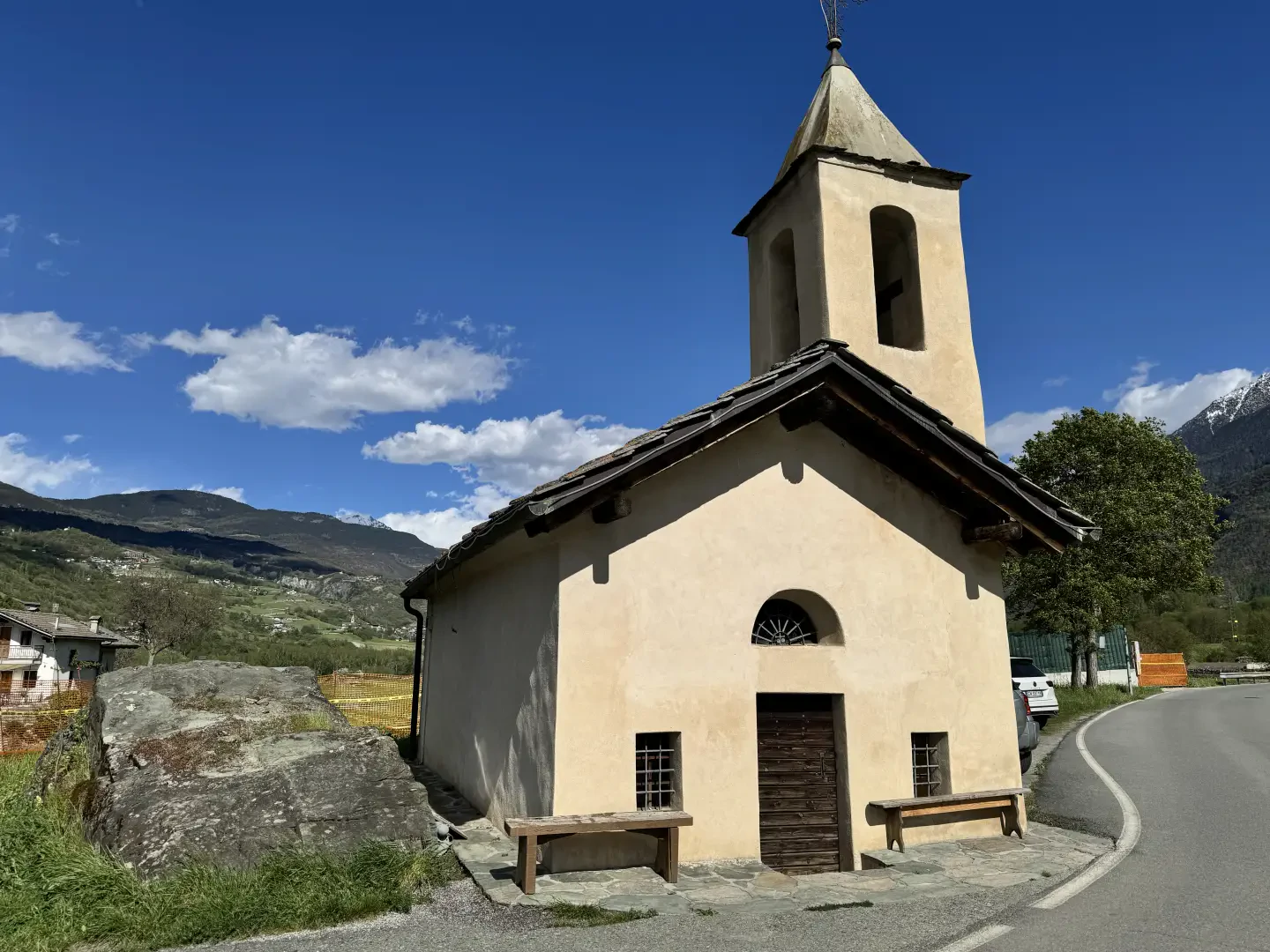
Perched on a small grassy promontory dominating the central plain of the Valle d'Aosta, the chapel of Les Crêtes in Fénis is a place of silent charm, dedicated to Saint Leonard. Surrounded by fields and vineyards, this small rural church holds fragments of history and popular devotion, telling of an ancient bond between the community and its territory.
Description
Probably built between the 15th and 16th centuries, the chapel has a simple and intimate structure, typical of minor Alpine religious architecture. The walls, once entirely frescoed, preserve traces of votive decorations that suggest a rich iconographic tradition, unfortunately partly lost with the passing of the centuries. The slate roof, with its sober covering of local stone, harmonises perfectly with the surrounding landscape, while the small bell gable recalls the essentiality and authenticity of the mountain faith.
In spite of its small size, the chapel of Les Crêtes occupied an important role in rural life: Saint Leonard, patron of prisoners and protector of domestic animals, was venerated for the protection of stables and crops. Even today, the site retains a suspended, almost untouched atmosphere that invites pause and reflection, far from the beaten track.
The figure of Saint Leonard of Noblac, to whom the chapel is dedicated, has its roots in the early Middle Ages. Born in Gaul around the 5th century, Leonard renounced the honours of the Frankish court to lead a hermit life. Famous for having obtained the liberation of many prisoners by virtue of his spiritual intercession, he was soon also associated with the protection of births and agricultural activities, becoming one of the most venerated saints in the rural communities of Europe.
A visit to the chapel of Les Crêtes, perhaps following the paths that climb gently between vineyards and meadows, allows one to rediscover the most intimate sense of a landscape in which history, faith and nature continue to intertwine in a discreet and authentic manner.