Campania

Edited by:
Massimo Martini
Access
Road navigation
Campania is accessible from northern and central Italy via the motorway network. From the motorway (Milan–Naples), the main access points are the Napoli Nord and Caserta Sud exits. From the Caserta Sud exit, continue on the towards Naples. The (Naples–Salerno) serves the southern part of the region. The (Naples–Canosa) links the region to Puglia through Irpinia. From the (Salerno–Reggio Calabria), the Province of Salerno and the Cilento area are reached.
Public transport
The region is served by the high-speed rail network on the Rome–Naples–Salerno axis, with stations at Naples Centrale, Naples Afragola and Salerno. Naples International Airport (Capodichino), located approximately 4km from the city centre, is the region's main airport. For timetables and rail connections: Trenitalia.
Distance and travel time
🕒 Rome–Naples: approx. 2h30' by car (220km)
🕒 Milan–Naples: approx. 7h00' by car (780km)
GPS navigation
Information note
The directions provided were verified at the time of the survey. Before departure, it is advisable to check for any changes to the route or road conditions. For up-to-date information, consulting Google Maps or Apple Maps is recommended.
Introduction
Campania is an ordinary-statute region of southern Italy, with Naples as its regional capital. It extends between the Tyrrhenian Sea to the west and the southern Apennines to the north-east, bordering Lazio to the north-west, Molise to the north, Puglia to the north-east and Basilicata to the east. The territory is structured in three parallel bands: an inland mountainous sector corresponding to the Campano-Lucanian Apennines, with massifs such as the Matese, Taburno, Picentini and Cervati; a hilly and low coastal plain belt; and a third, discontinuous component formed by the islands of the Gulf of Naples — Ischia, Capri, Procida, Vivara and Nisida — of volcanic or limestone origin. The region is divided into four provinces and one metropolitan city: Avellino, Benevento, Caserta, Naples and Salerno, for a total of 550 municipalities. By population, it is Italy's third most populous region and the most populous in the Mezzogiorno.
Description
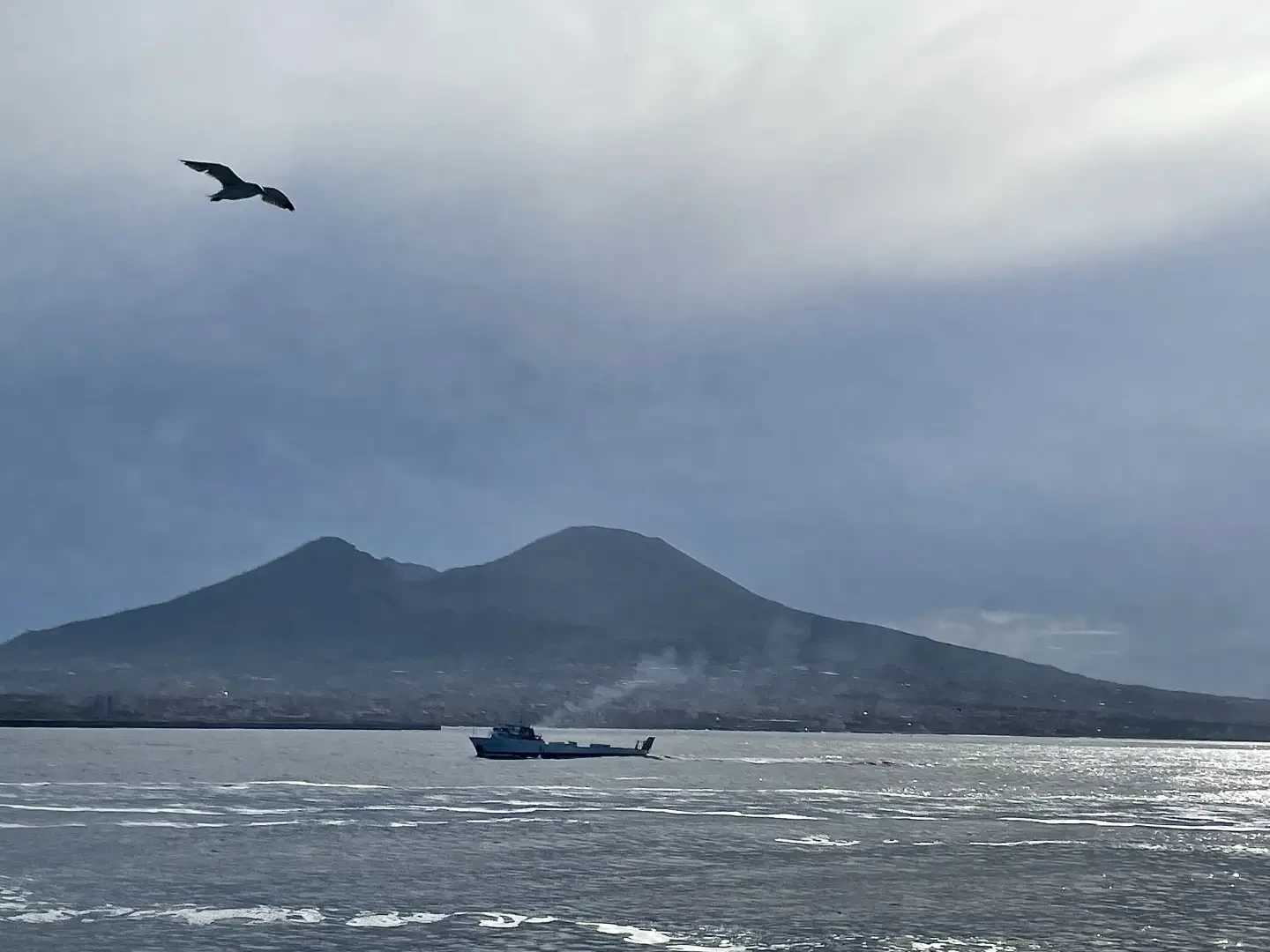
From a physical standpoint, the Campanian territory develops across three major morphological systems. The interior is dominated by the Apennine ridge, with a succession of limestone and volcanic massifs reaching the highest elevation at Monte Miletto (2.050m), in the Matese group, on the border with Molise. The volcanic zones include the Somma-Vesuvius system, the Phlegraean Fields and the Ischia complex with Monte Epomeo (789m), together with the quiescent volcano of Roccamonfina. The main watercourses are the Volturno, the longest river in southern Italy at about 170km, and the Sele, which crosses the Salerno area. Natural lakes are mostly small in size; the most significant are the Matese lake, of karst origin, and Lake Avernus, a volcanic crater of the Phlegraean Fields. The coastline, articulated around the gulfs of Gaeta, Naples, Salerno and Policastro, extends for approximately 500km including the island shores.
The earliest traces of human settlement date to the Lower Palaeolithic. In the first millennium BC the territory was inhabited by Osco-Samnite populations in the interior and Greek colonists along the coast, where centres such as Cumae, Paestum and the future Naples developed. Under Roman rule, the region was called Campania Felix for the fertility of its soils. After the fall of the Western Empire, the territory was contested between Lombards and Byzantium, with the emergence of autonomous entities such as the Duchy of Naples and the maritime republics of Amalfi and Gaeta. In the twelfth century, Campania was unified under the Norman crown of the Kingdom of Sicily. Between the thirteenth and nineteenth centuries, the succession of Angevin, Aragonese, Habsburg and Bourbon dynasties made Naples one of Europe's principal political and cultural centres. Key episodes of this period include the short-lived Parthenopean Republic of 1799 and the construction of the Royal Palace of Caserta, completed in 1845 to designs by Luigi Vanvitelli. With Italian unification in 1861, the region was annexed to the kingdom, initiating a long integration process that also marked the beginning of migratory flows towards northern Italy and abroad. The Irpinia earthquake of 23 November 1980, measuring 6.9 in magnitude, caused approximately 2,900 deaths and over 280,000 displaced persons, leaving lasting effects in the provinces of Avellino and Salerno.
The regional economy rests on three main pillars. Agriculture, particularly developed in the alluvial plains of the Volturno and Sele rivers, produces fruit and vegetables — including San Marzano DOP tomatoes and piennolo DOP tomatoes —, citrus, vines and olives with four DOP designations. Products of national significance include mozzarella di bufala campana DOP, produced mainly in the provinces of Caserta and Salerno, and Gragnano pasta, whose production cycle dates to the sixteenth century. The wine sector counts four DOCG designations: Taurasi, Fiano di Avellino, Greco di Tufo and Aglianico del Taburno. Industry is concentrated in the Naples metropolitan area, with significant presence in the mechanical, aerospace and naval sectors. Tourism is the fastest-growing sector, underpinned by six UNESCO World Heritage sites — including the historic centre of Naples, the archaeological areas of Pompeii and Herculaneum, the Amalfi Coast and the Royal Palace of Caserta — and a coastal and naturalistic offer distributed throughout the entire shoreline. The regional architectural heritage includes structures from the Greek, Roman, Norman, Angevin, Aragonese, Baroque and Neoclassical periods, with a particularly high concentration in the regional capital and its hinterland.
Protected natural areas cover approximately 25% of the regional surface. The national parks present are the Vesuvius National Park, the Cilento, Vallo di Diano and Alburni National Park, and the Matese National Park. These are supplemented by numerous regional parks, including the Monti Picentini, Partenio, Taburno-Camposauro, Roccamonfina-Foce Garigliano, Phlegraean Fields and Monti Lattari. The Cilento, in the southern part of the Province of Salerno, is the largest natural sub-region and forms, together with the Vallo di Diano and the Alburni, the largest national park in Campania. The inland fauna includes the Apennine wolf, present in the mountainous areas of the Matese and Irpinia.
Information
Information
regional capital: Naples
area: 13,670.95 km²
minimum altitude: 0m
highest point: 2,050m – Monte Miletto (Matese)
population: 5,570,191 (November 2025)
inhabitants: Campanians
provinces and metropolitan city: Avellino, Benevento, Caserta, Naples (metropolitan city), Salerno
municipalities: 550 – [list] – [map]
bordering regions: Basilicata, Lazio, Molise, Puglia
institutional website: www.regione.campania.it
Natural environment
islands – map
lakes – map
passes and cols – map
protected areas – map
summits – map
volcanoes – map
Cultural heritage
archaeological sites – map
boroughs – map
castles – map
churches – map
places of worship – map
UNESCO sites – map
Hiking infrastructure
bivouacs – map
mountain huts – map
Routes
hiking [to be completed] – map