Annecy

Edited by:
Massimo Martini
Access
The municipality can be reached from the motorway via the Annecy-Nord exit, which connects the town to the Chambéry-Geneva axis to the south and the French motorway network to the north. The national road runs along the western shore of the lake towards Albertville and Chambéry. The departmental road forms the main axis connecting the municipalities on the eastern shore of the lake, while the serves the Semnoz side towards Seynod. Annecy railway station is a hub of the SNCF (Société Nationale des Chemins de fer Français) network, connected to Paris by the TGV Intra-oui service with a change in Chambéry or Lyon, and to regional destinations with the TER Auvergne-Rhône-Alpes service. Geneva-Cointrin International Airport, about 45 km away, is the main air terminal; Lyon-Saint-Exupéry Airport is about 140 km away. Urban public transport is managed by Sibra with bus lines covering the six delegated municipalities. There are no seasonal criticalities on road accessibility on the valley floor; roads to the alpine pastures and the Semnoz station may be subject to winter closures.
Introduction
Annecy is the capital of the département of Haute-Savoie (Haute-Savoie) and seat of the prefecture, located in the Auvergne-Rhône-Alpes (Auvergne) region at an altitude of 448m, on the northern shore of the lake of the same name. The municipal territory, resulting from the merger of six entities in 2017, includes both the historic urban core and the delegated municipalities of Annecy-le-Vieux, Cran-Gevrier, Meythet, Pringy and Seynod, with a total area of 66 km². Its geographical location is a transition between the pre-Alpine environment - with the Semnoz massif to the west and the Bornes and Bauges massifs to the east - and the Fier plain to the north. Lake Annecy, of glacial origin, occupies the southern portion of the territory and its natural outlet, the Thiou, flows through the historic centre before flowing into the Fier. The first historical records date back to a Roman settlement known as Boutae; the medieval core developed on the castle promontory, becoming the residence of the Counts of Geneva and then, from 1401, of the Dukes of Savoy. The commune is bordered to the north by Épagny-Metz-Tessy, to the east by Argonay and Veyrier-du-Lac, to the south by Sévrier and Duingt and to the west by Chavanod and Poisy.
.Description
The territory of Annecy is divided into three distinct environments: the northern plain of the Fins, the lake shore, and the wooded slope of the Semnoz massif in the south-west, which reaches a maximum altitude of 1,699m at Crêt de Chatillon. Lake Annecy has a maximum depth of 80m and is fed by mountain springs; the Thiou, its emissary, flows for 5 km through the town before flowing into the Fier. The Annecian slopes of the Semnoz are covered with mixed forests and scrubland formations; the territory of the massif is partly included in the Réserve Naturelle Nationale du Bout du Lac and in the Parc Naturel Régional du Massif des Bauges conservation area.
The settlement of the area dates back to at least 3100 BC, as recent excavations have shown. In Roman times, around 50 B.C., a vicus of around 2,000 inhabitants called Boutae existed on the Fins plain, of which the forum, basilica, baths and theatre have been identified. The medieval core was established on the promontory of the castle in the 11th century under the name Annecy-le-Neuf, becoming the residence of the Counts of Geneva until their expulsion by the bishopric. After the extinction of the lineage in 1394 - whose last representative, Robert of Geneva, became antipope under the name of Clement VII - the county passed to the Savoy in 1401 under Amadeus VIII. In 1444, the city was raised to a princely appanage and became the capital of Geneva, Faucigny and Beaufortain. From 1535, with the departure of the bishop of Geneva on the eve of the Protestant Reformation, Annecy became an episcopal see and the pole of the Catholic Counter-Reformation, attracting numerous religious orders: between 1592 and 1648, the Capuchins, the Visitandine founded by Francesco di Sales and Giovanna Francesca di Chantal, the Barnabites and others. The period left a lasting impression on the monumental heritage. With the French Revolution, the town was aggregated to the Mont Blanc department; with the Restoration, it returned to the Kingdom of Sardinia, and with the annexation of Savoy to France in 1860, the phase of industrialisation began, favoured by the hydraulic exploitation of the Thiou.
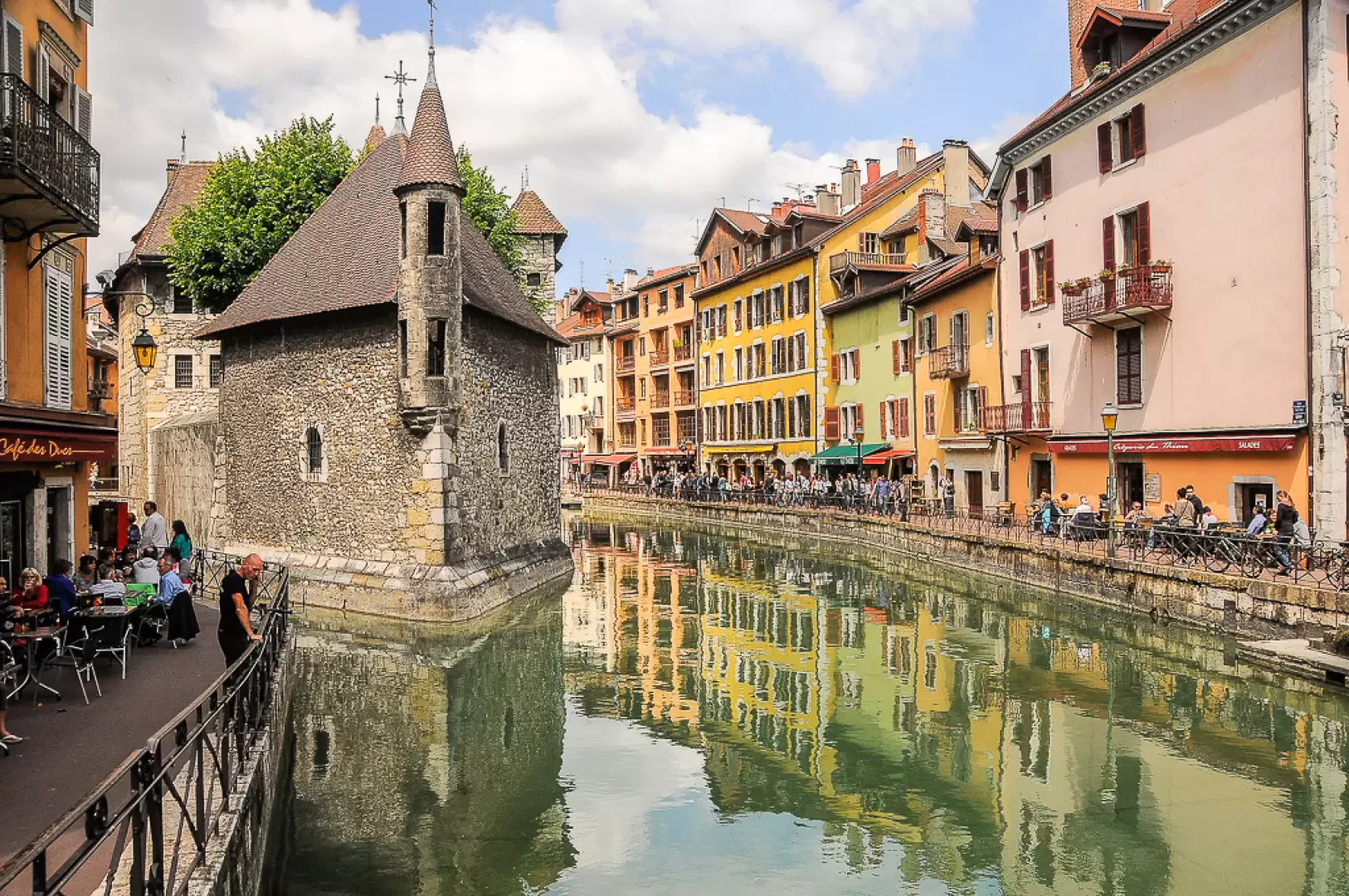
The monumental heritage includes the Castle of Annecy, the medieval residence of the Counts of Geneva located on the last spur of the Semnoz at 470m, and the Palais de l'Isle, a 13th-century building on a river island in the Thiou Canal, which has served throughout history as a courthouse, mint and prison. The Cathedral of St. Anthony of Padua and the Basilica of the Visitation complete the profile of the religious old town. The economy is based on lake and mountain tourism, a fabric of small and medium-sized precision industry and a university that attracts a significant student population. The Semnoz massif is home to a ski resort and a network of footpaths that can be explored in all seasons; the network of hiking itineraries extends both on the lake side and on the summit plateau of Crêt de Chatillon, with access also by mountain bike and snowshoes in winter.
.Information
General Data
Area: 66 km²
Main town elevation: 448m
Main elevation: 1,699m - Crêt de Chatillon
Number of inhabitants: 132.117 (as of 01.01.2023, INSEE)
Name in Arpitan: Ènneci
Name of inhabitants: annecians (Annéciens)
Patron saint: [to be completed]
Neighbouring municipalities: Argonay - Chavanod - Épagny-Metz-Tessy - Nâves-Parmelan - Poisy - Sévrier - Veyrier-du-Lac
Department of affiliation: Alta Savoie
Region of affiliation: Alvernia-Rodano-Alpi
Nationality: France
Institutional site: https://www.annecy.fr