Acquafredda Abbey

Edited by:
Massimo Martini
Access
To reach the abbey complex in Acquafredda, in the Lenno area (municipality of Tremezzina), drive to the signposted car park or walk from Val Perlana.
Road directions
Leave the at the Lago di Como exit and join the towards Tremezzina. Continue on the for 1.5 km (1.5 km), then at the roundabout take the third exit, staying on the for 170 m (1.7 km). Take the junction on the left onto the and follow it for a further 22.0 km (23.7 km). Turn left onto Via Armando Diaz and, after 12 m (23.7 km), turn left onto Via Silvio Pellico for 1.0 km (24.7 km). Turn slightly left onto Via degli Alpini for 650m (25.3km) and continue along Via dell’Alpe: after 9m (25.3km), your destination is on the right.
Car park
In the village of Acquafredda, there is a free 🅿️ car park near the abbey complex.
Access by public transport
To reach the abbey complex, you’ll need a private vehicle, as the area isn’t served by public transport.
Access on foot
from Ossuccio | Val Perlana circuit, from Ossuccio
Distance and journey time
🕒 Journey time: 36 minutes
📏 Distance: 25.3 km
GPS navigation
Important information
The directions provided were verified on the date the route was mapped. Before setting off, we recommend checking for any changes to the route or road conditions. For up-to-date information, please consult Google Maps or Apple Maps.
Introduction
The Abbey of Acquafredda is a former Cistercian abbey complex in the village of Acquafredda, in the Lenno area, within the municipality of Tremezzina, in the province of Como. It is situated on the western slope of Lake Como, at the foot of Mount Ossino, above the village of Lenno. The complex comprises the church of Santa Maria dell’Uliveto, the bell tower with the oratory of San Pietro at its base, and the former monastery. It was founded in the 12th century by Cistercian monks from Morimondo Abbey, on land donated to them in the locality of Roncate, and takes its name from a cold spring situated nearby. The property belongs to the Capuchin Friars Minor and the complex is in a state of neglect.
Description
The complex occupies a plateau at the foot of Mount Ossino, in an area once known as Roncate or Roncale. The name Acquafredda derives from a spring that still flows nearby. The church is also known as the Church of Monte Oliveto or Santa Maria d’Uliveto.
In 1142, the relics of Saint Agrippinus, which until then had been kept on theIsola Comacina, were transferred to a chapel dedicated to St Peter in the village of Roncate. The chapel and the surrounding land were donated to the Cistercians of Morimondo by Azzo, known as Pellegrino da Isola, also known as Azzo Peregrino. The abbey was founded in 1143 and dedicated to Mary, Peter and Agrippino. Construction of the church began in 1153 and it was consecrated in 1193.
At the beginning of the 16th century, the abbey came under commenda. It was plundered and occupied by the troops of Gian Giacomo Medici and Francesco II Sforza, and in 1527 it was set on fire. Sources attribute the order to set the fire either to the governor of Como, who intended to flush out some outlaws taking refuge in the complex, or to Count Ascanio Bergamino. Returned to the monks in 1547, it was remodelled in the 17th century and renovated in 1774. It was suppressed in 1785: the monks moved to the Certosa di Pavia and, in 1787, the complex was purchased by the Milanese banker Ignazio Mainoni. In 1809, the property was inherited by Francesco, who sold it to Carlo Bonomi in 1812. A period of neglect followed, during which the complex became a hideout for bandits.
From 1904 to 1910, Benedictine monks from the Abbey of Saint Mary Magdalene in Marseille resided there. The complex then served as the summer residence of the seminary of the Diocese of Crema and, in 1934, was purchased by the Capuchin Friars Minor. In 1966, it was entrusted to the Third Order Regular of St Francis as a house of prayer and spiritual retreat, and subsequently to a women’s community of Franciscan spirituality, the Handmaids of the Lord. In February 2024, a co-design forum was launched for the restoration and social reuse of the building, involving the owners and the municipality of Tremezzina.
The church has a single-nave plan with two side chapels and a polygonal apse, and is preceded by a portico. The walls are built of Moltrasio stone blocks, plastered both externally and internally; the roof is gabled with wooden trusses and covered with clay tiles. The complex also includes the sacristy, the bell tower with the Oratory of San Pietro at its base, and the former monastery. The entrance is marked by a stone portal bearing the Capuchin emblem. Visible remains of the medieval structure include the apse, the burial place of SaintAgrippino and, with less certainty, the base of the bell tower.
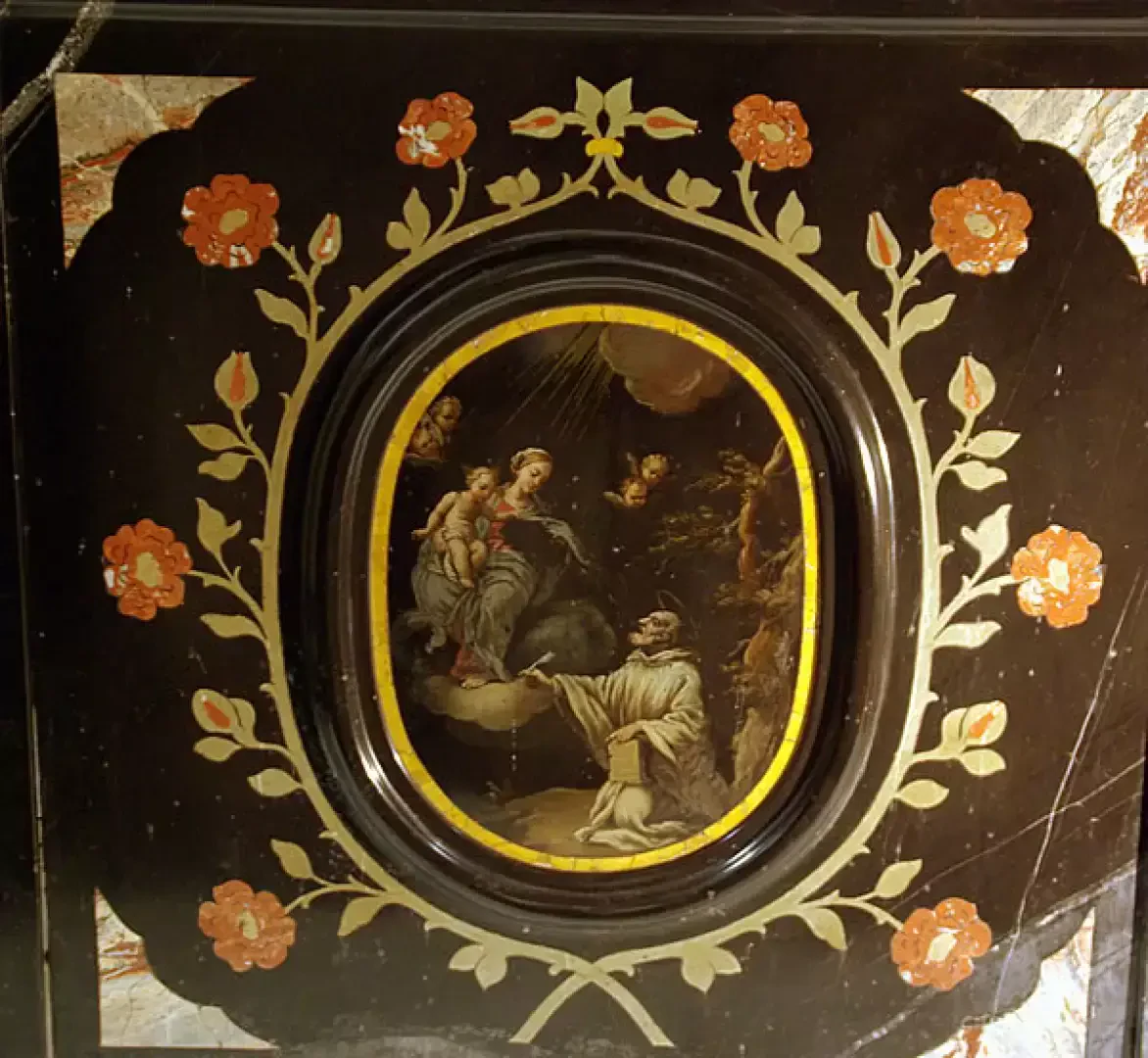
The frescoes in the chapels and the choir are by Giovanni Mauro Della Rovere, known as ‘il Fiammenghino’, who worked at Acquafredda in 1621. His works include an oil painting of the Annunciation, a ‘Miraculous Catch’, a ‘Martyrdom of Saint Paul’, a painting of Saint Agrippinus and depictions of Saints Charles Borromeo, Peter, Paul and Bernard of Clairvaux. The altar dedicated to St Bernard has an altar frontal depicting the Madonna del Latte. The vault and stucco work date from 1680, whilst the marble high altar dates from 1714 and was commissioned by the abbot, Don Giusto Rossi. In the basement there is a fresco depicting the Triumph of Bacchus.
Information
General information
Type: places of worship, abbeys
Other names: Santa Maria dell’Uliveto (church); Acqua Fredda Abbey of the Friars
Period: 12th century
Style: Romanesque layout with 17th-century alterations
Dedication: Santa Maria, San Pietro and Sant'Agrippino
Location: Acquafredda, Lenno
Municipality: Tremezzina
Region: Lombardy
Country: Italy
Ownership: Province of Lombardy of the Capuchin Friars Minor
State of conservation: in a state of neglect
Religious order: Cistercian (foundation)