
Edited by:
Massimo Martini
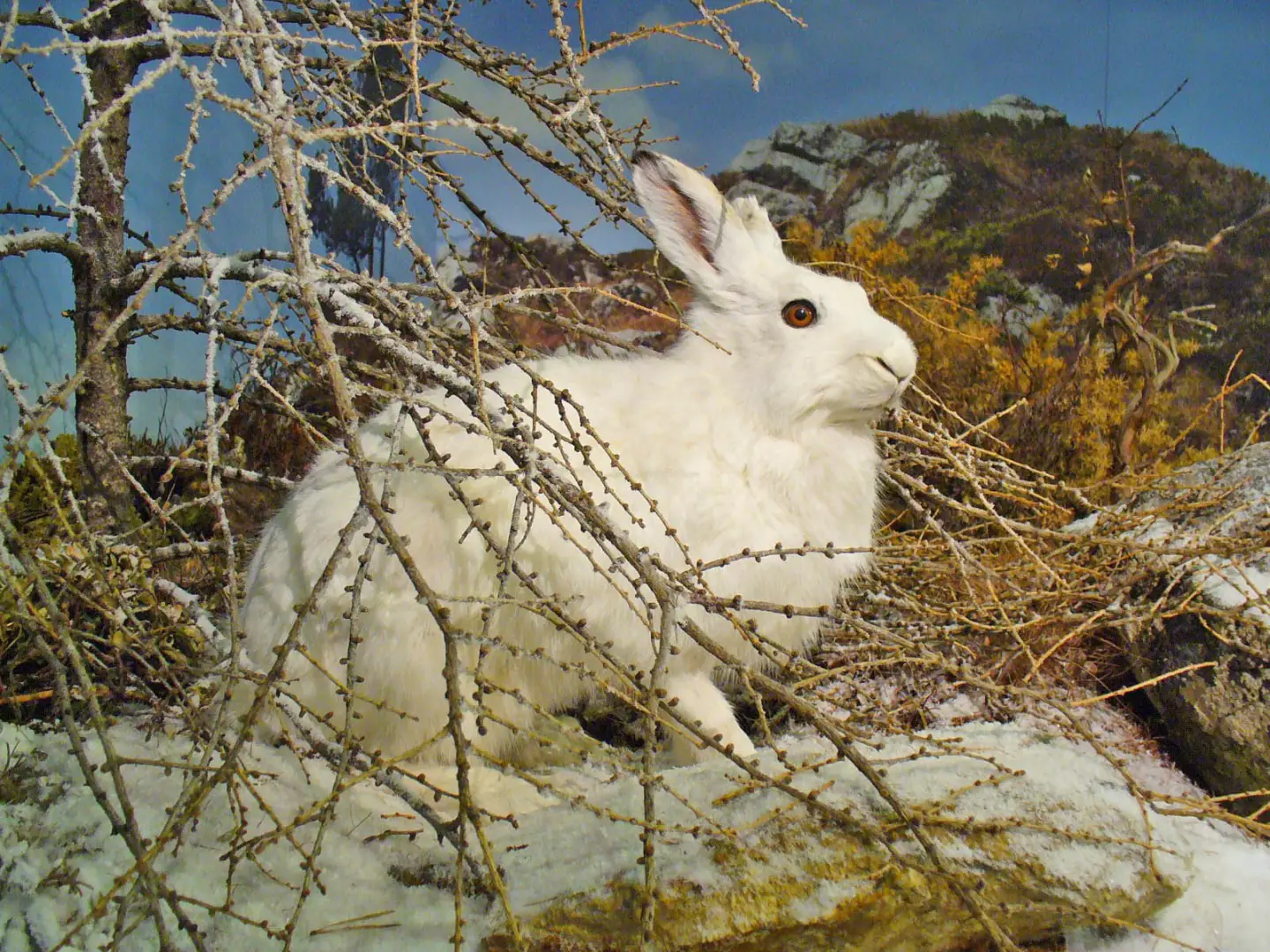
The mountain hare (Lepus timidus) is a high-altitude lagomorph, found throughout the Alps at altitudes between 1,000 m and 3,500 m. It owes its common name to its coat, which changes from brownish-grey in summer to white in winter. In Italy, it is found exclusively in the Alps.
The mountain hare (Lepus timidus) is also known as the alpine hare or white hare, a name linked to the seasonal change in its coat: brownish-grey in the summer months, with a tail that remains entirely white all year round, and pure white in winter. It is a polytypic species, with some sixteen subspecies described across its entire range; the subspecies Lepus timidus varronis is found in the Alps. It measures 43–64 cm in head-body length, with ears measuring 6.3–10.6 cm and a weight ranging from 1.4 kg to 4.7 kg; females weigh on average 300–400 g more than males.
In the Aosta Valley, it occupies the entire altitude range between 1,000 m and 3,500 m, moving seasonally: it descends to lower altitudes in winter, where food is more readily available, and ascends again in summer. It is mainly active at dusk and at night, does not hibernate, and leads a predominantly solitary life; during the breeding season, between April and August, the males become territorial.
The species is closely related to the European hare (Lepus europaeus), with which it shares part of its range and can produce fertile hybrids. A study conducted between 2009 and 2021 by ISPRA and the University of Turin in a valley within the Gran Paradiso National Park, in the Aosta ValleyAosta, documented a shift of the mountain hare towards higher altitudes, attributable to the rise in average temperatures and the concurrent ascent of the common hare to higher altitudes, facilitated by the same warming trend. Due to this sensitivity, the mountain hare is considered a ‘sentinel’ species for Alpine climate change.
In terms of conservation, its global IUCN conservation status is ‘Least Concern’ (Least Concern), although a declining trend has been recognised in the IUCN review of European hare species. The Italian regulatory framework, however, operates on two distinct levels: at national level, the species is classified as huntable underArticle 18 of Law 157/1992, with a hunting season running from 1 October to 30 November, and is also included as such in Aosta Valley Regional Law 64/1994. Since 2019, however, the Regional Council of Valle d’Aosta has suspended hunting of the species via the hunting calendar, invoking the precautionary principle due to uncertainty regarding the available data and the pressure of climate change; in 2021, the Aosta Valley Regional Administrative Court (TAR) dismissed the appeal lodged against the suspension, confirming its legitimacy as an administrative act.
Identification in the field is based primarily on colouring: unlike the brown hare, which remains brown all year round, the mountain hare takes on a completely white coat in winter, whilst retaining its white tail in all seasons (in the common hare, the upper part of the tail is black). Its ears are relatively shorter than those of the common hare. It is an elusive species and rarely observed directly: a camera trap survey carried out in the Veglia and Devero Alps (Piedmont) recorded a lower occupancy rate compared to other mammals present in the same area; indirect observation via tracks in the snow is more common than direct sightings.
Fact sheet
Common name: Tufted hare (Alpine hare, white hare)
Scientific name: Lepus timidus Linnaeus, 1758
Species: placental mammal Family: Leporidae, order Lagomorpha
Distribution: Northern Europe, Scotland, Ireland, northern Asia as far as Siberia and northern Japan; in Italy, restricted to the Alpine range
Habitat: high-altitude environmentshigh-altitude environments, between 1,000 m and 3,500 m, ranging from sparse woodland to alpine grasslands and rocky areas
Diet: herbivorous — grasses, buds, bark, shoots