Châtel-Argent

Edited by:
sonia_f
Access
Introduction
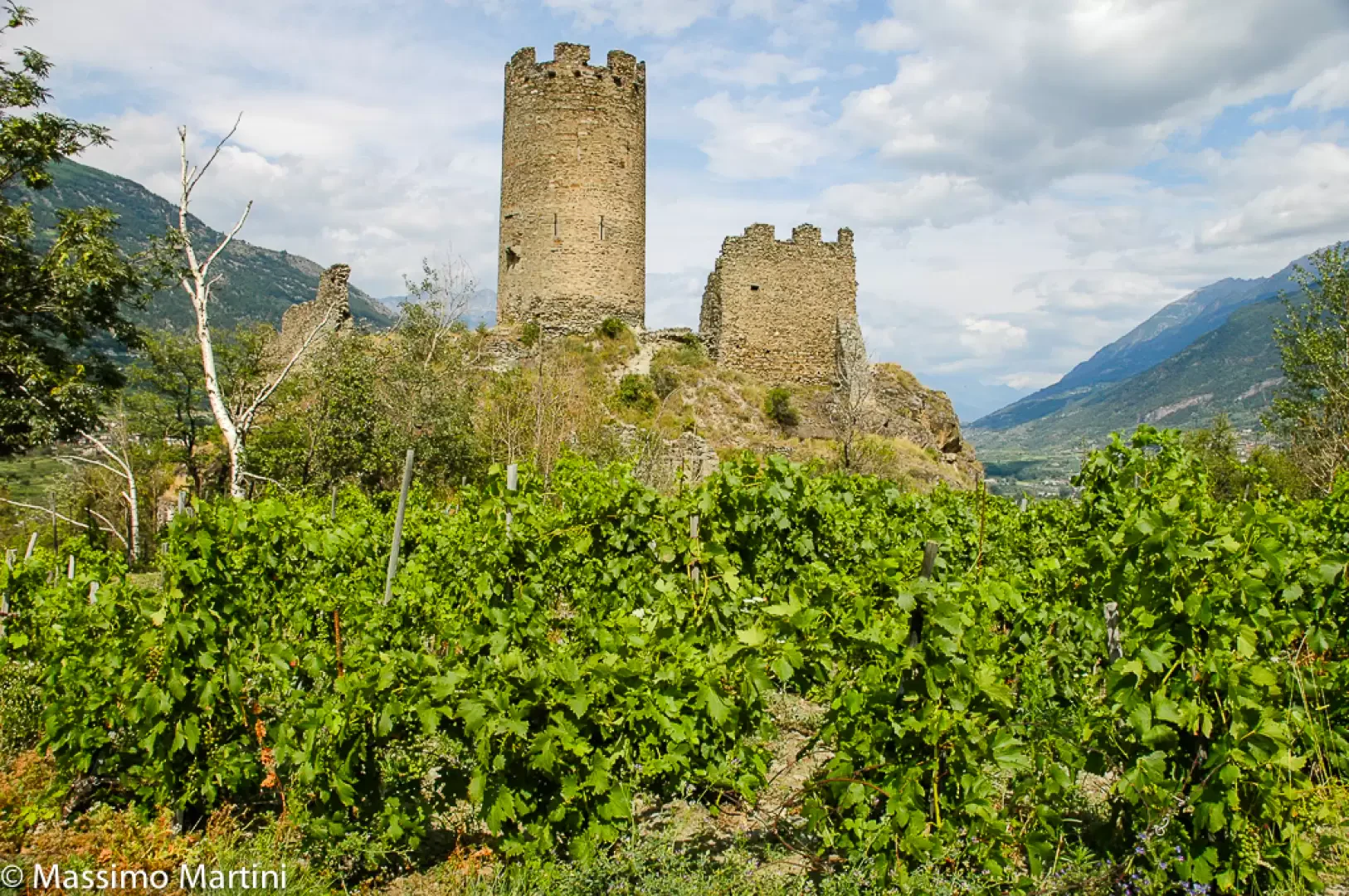
The castle of Châtel-Argent, so called because coins were minted there, stands in the commune of Villeneuve, on a steep cliff overlooking the village, at the point where the valley tends to narrow. The particular geographic conformation makes the place an excellent point for controlling the Dora and the territory, upstream and downstream. These conditions have always constituted an attraction, so much so that the area where the Châtel-Argent castle stands has been inhabited since protohistoric times, as testified to by the anthropomorphic stele found in the area; even the Romans, noting its strategic importance, had to choose the peak as the site for a fortress, as also testified to by material evidence (marble tombstones and embryos used in the masonry of the chapel).
.Description
Historical background
Already before the castle was built, a Roman fortress existed on the hill above Villeneuve, so much so that material evidence can be found such as tombstones with inscriptions and bricks reused in the construction of the chapel. Moreover, the Romans themselves had in all likelihood been preceded by older populations, as can be deduced from an anthropomorphic stele from the protohistoric period found on the site.
The chapel, the oldest element of the castle, can be dated, based on type-morphological considerations, to the second half of the 11th century, probably between 1050 and 1075.
In the 11th century, Otto of Bard owned the fiefdoms of Bard, Pont-Saint-Martin and Châtel-Argent; in 1191, a Hugh or Ugone of Bard paid homage to the Count of Savoy, but the toponym Castrum Argenteum appears as early as 1176.
In 1242, two of Ugone of Bard's sons, Anselm and Hugh II, who had both inherited the castle of Châtel-Argent and were therefore in dispute with each other, refused to pay homage to Count Amadeus IV, who threatened to confiscate the fiefs of the two brothers; however, after some negotiations, Anselm and Hugh sold their properties to the count and retired to Burgundy.
At this point, Amadeus IV enfeoffed the fief of Châtel-Argent to Mark and Aimon, sons of Hugh II, who left the name of Bard in favour of Sarriod d'Introd and Sarriod de la Tour respectively.
In 1279, William Sarriod, younger brother of Mark and Aimon, in his will left his share of the castle of Châtel-Argent to his wife Leonarda, who lived there with their sons Rudolf, William and Peter. At this point, it becomes difficult to follow the course of the succession and sales of the different portions of the castle property, as the homonymy between the castle of Villeneuve and the Châtel-Argent château, which extended over Villeneuve and Saint-Pierre, led to confusion in the attribution of documents.
What is certain is that at the end of the 16th century Châtel-Argent reverted to the Savoy family, until 1605 when Charles Emmanuel I enfeoffed Pietro Leonardo Roncas, Marquis of Caselle, as Baron of Châtel-Argent.
The castle was abandoned shortly after 1780, and currently remains as a ruin, clearly visible above the village of Villeneuve.
Architectural description
The constituent elements of the castle of Châtel-Argent are essentially the tower, the enclosure and the chapel; next to the tower is the cistern for collecting water, while along the wall, again near the tower, the grafts of the walls of now-destroyed buildings, corresponding to the original residence buildings, can be discerned.
The oldest building in the complex is the chapel, datable to the mid-11th century, between 1050 and 1075, and therefore pre-existing with respect to the castle, whose current appearance should date back to the second half of the 13th century.
The chapel is built against the eastern portion of the boundary wall, with the apse part totally extra muros, and is canonically oriented with the entrance front to the west and the altar area to the east. The chapel has a longitudinal plan and a single nave ending in a semicircular apse, concluded by the apsidal basin; the space measures 8.4 by 5.6 metres, and the masonry is mainly made of rubble, but there are also bricks, recovered material from previous Roman settlements.
The simplicity of the layout corresponds with the simplicity of the exterior decoration, which is not, however, lacking in elegance. The entrance front has a framed portal, ideally recalling the internal apsidal arch, complemented by the arch and pilaster decoration that also marks the apse and the southern front, but here the small arches are missing, probably victims of the passage of time; the upper part of the façade is pierced by a round-headed window about one metre wide. Instead, on the curved apse wall, which extends outside the walls, there are two thin single lancet windows with double splays, similar to the two that pierce the southern façade. The north-facing front is the most meagre, not having any openings, nor the albeit simple decorations of the other façades, and is simply plastered.
The chapel must originally have been covered by a wooden roof, but it is now open to the sky, thus not losing a kind of sacredness and still offering visitors a particular and almost sublime charm.
The interior walls were all decorated with frescoes of which some chromatic traces remain, but which are now unrecognisable and destined to disappear. Carlo Nigra testifies to this by describing the apse as it was seen in the 1930s: 'The apse is internally coloured with yellow, red and green ochre and shows crudely painted representations of the Baptism of Christ and the Madonna enthroned with Child between two saints, perhaps St Eusebius or St Grato."On the opposite side of the enclosure is the circular tower; this is 15 m high, has an inner diameter of 5.5 m and an outer diameter of 9 m, so the walls are about 1.7 m thick. The tower is crowned by a rectangular battlement, beneath which can be seen the stone modillions arranged to support the wooden bertesche; bertesche are defensive completion works, which were made of stone or wood for the purpose of providing greater cover for soldiers engaged in attacking enemies.
Along the exterior surface, the tower has slits, which give light to the interior rooms; these are necessarily very splayed, given the great thickness of the walls. The tower also still has the pontaie holes, those holes intended to accommodate the scaffolding supports, arranged in a helical pattern. Remaining on the outside, we note the presence of the entrance door to the tower, placed at a height of approximately 5.5 m above the ground.
The wall face is of very good quality: in fact, the stone courses are regular, the lime is of good quality and the proportion between stone material and binder is correct; there are also short pieces of masonry made of opus spigatum. The tower of Châtel-Argent has the characteristic of having sub-masonry arches instead of the traditional thickening scarp of the base section: this maximises the defensive capacity in the event of an attack with mines (the tunnels that were dug underneath fortified works to induce their collapse).
Internally, the tower was divided into three floors, the lower of which was completely dark; on one floor there is a chimney, a sign that the castellan lived in the tower, at least occasionally.
As for the circular tower typology, it should be noted that this was adopted by Peter II of Savoy, who had in his service a skilled military engineer, James of Saint-George d'Espéranche, known as Magister Jacobus de Sancto Georgis. The latter worked for the Duke of Aosta and then went on to serve his nephew, Edward I, King of England, for whom, under the name of Magister James of Saint George, he built numerous castles. The traditional square tower, derived from the Roman model adopted in the Romanesque period, was abandoned in favour of the round tower, no longer placed in the middle of the enclosure but close to the walls, intended mainly for guarding, and defence only in extreme cases.
The 85 cm thick enclosure wall encloses an area about 90 m long and 70 m wide, which according to Nigra could accommodate more than 2000 soldiers. The enclosure doubles at the tower, where there is a double fence to further protect the tower, the cistern and the residential buildings, which no longer exist. In some sections, the most exposed to possible enemy attack, the enclosure wall was internally reinforced by a series of pillars, built in adherence to the masonry in the form of buttresses, connected to each other at the top by round arches on which the patrol walkway rested.
Near the tower is that fundamental element that is the cistern for collecting water; it is a small rectangular room, buried and vaulted in stone.
Curiosity
A small curiosity concerns the water cistern of the Châtel-Argent castle. In his Historique de la Vallée d'Aoste, de Tillier describes the cistern by saying that the pinkish colour of its plaster is given by wine sediments. This is a curious oversight on the part of the famous 18th-century historian, as the pinkish colour of the plaster, which is also found in the cisterns of other castles, is the result of a special construction technique.
The plaster of a cistern must be in contact with water without being damaged by it, and must therefore be impermeable; for this to happen, the plaster must be made of a mortar that is called hydraulic because it has the power to harden in contact with water.
Before the spread of Portland cement, at the end of the 19th century, a mortar with hydraulic properties could be obtained by adding an additive to the traditional mixture of lime, water and sand, which gave the mixture hydraulic properties. The Romans, who needed it to realise their great hydraulic works (aqueducts, baths, etc.) were familiar with a number of additives suitable for this purpose, including pozzolana, a sand of volcanic origin that gave the finished plaster a characteristic grey colour, and cocciopesto, finely ground brick powder. The use of cocciopesto spread easily in northern Italy, where there were no volcanoes that could supply pozzolana and vice versa clay, the raw material for making bricks, abounded.
The plaster rendered hydraulic by the addition of cocciopesto thus takes on a pinkish hue precisely because of the brick dust it contains, as in the case of the Châtel-Argent cistern, and not because of the prolonged presence of wine deposits, as de Tillier naively assumed.