
Edited by:
redazione
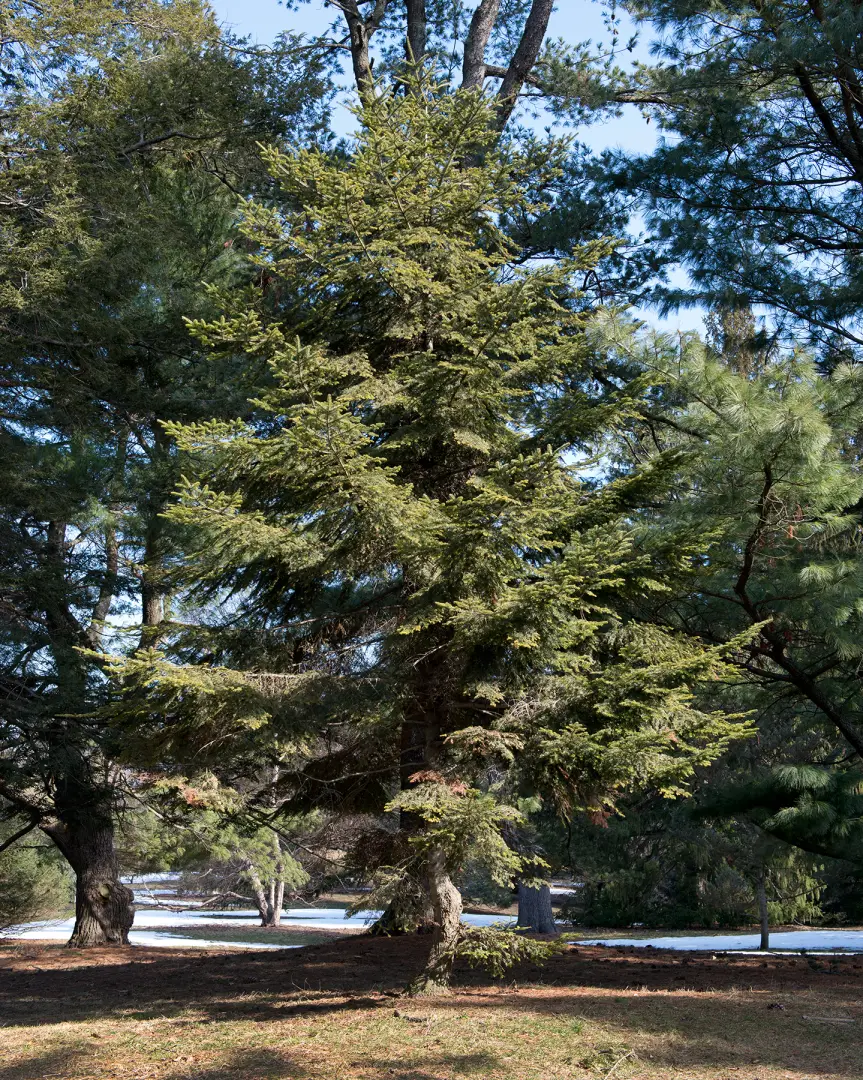
Elegant and majestic, the silver fir (Abies alba) is one of the most iconic trees of European forests, where it stands out with its slender form and perfectly symmetrical conical crown. Belonging to the Pinaceae family, this evergreen conifer can reach impressive heights, often exceeding 50 metres, with some specimens even approaching 60 metres. Its straight, sturdy trunk is covered in bark that is initially smooth and silvery, but which, over time, cracks into darker patches, marking the passing of the years.
Its leaves – the characteristic flat, flexible needles – are a deep green on the upper surface, whilst the underside features two thin whitish stripes, a detail that contributes to the species’ common name. Unlike many other conifers, the silver fir has needles without sharp tips, making it easily recognisable and pleasant to the touch. The cones, or reproductive structures, grow upright on the upper branches and, once mature, disintegrate to release the seeds, leaving only the central axis attached to the branch.
This magnificent conifer is widespread in the mountain forests of central and southern Europe, from the Pyrenees to the Carpathians, finding its ideal habitat in the cooland humid areas of the Alps and the Apennines, where it is often found alongside beech in mixed forests. It prefers deep, well-drained soils, avoiding areas that are too dry or excessively acidic. Its ecological role is fundamental: as well as providing shelter for numerous animal species, it contributes to the stability of mountain slopes by preventing soil erosion.
There is no shortage of historic specimens of Abies alba, such as the “Avez del Prinzep” in Trentino, which for centuries was considered the tallest silver fir in Europe, standing at 54 metres before being felled by a strong wind in 2017. The longevity of this species is remarkable, with some trees easily exceeding 500 years.
Unfortunately, the silver fir is not immune to threats. Deforestation, climate change and air pollution are putting many of its forests under severe strain. Although it is not currently classified as an endangered species, the decline in populations in some regions calls for conservation measures and sustainable management to ensure its survival.
In addition to its ecological value, the silver fir has always been prized by humans for its many uses. Its timber, which is light yet strong, is used in joinery and the paper industry. Since ancient times, the resin has been used to produce balms and natural remedies, thanks to its expectorant and antiseptic properties. Even the essential oil extracted from the needles is known for its relaxing and revitalising effect. Although it does not produce edible fruit, its seeds provide a food source for many species of birds and small mammals.
A symbol of strength and longevity, the silver fir is much more than just a tree: it is a silent witness to the history of our forests, a green giant that continues to defy the passage of time and the elements, reminding us just how precious the natural world around us is.